Showing posts with label The Early Years. Show all posts

Friday, August 5, 2016

Bristol F.2 Fighter

 
The Bristol F.2 Fighter was a British two-seat biplane fighter and reconnaissance aircraft of the First World War developed by the Bristol Aeroplane Company. It is often simply called the Bristol Fighter or popularly the "Brisfit" or "Biff".


Top speed: 123 mph


Wingspan: 39′ 0″


Length: 25.82′


Retired: 1930


Unit cost: 1,350–1,350 GBP (1918)


First flight: September 9, 1916


Manufacturers: Standard Motor Company, Bristol Aeroplane Company


Sopwith 7F.1 Snipe

The Sopwith 7F.1 Snipe was a British single-seat biplane fighter of the Royal Air Force. It was designed and built by the Sopwith Aviation Company during the First World War, and came into squadron ...


Top speed: 121 mph


Wingspan: 31′ 0″


Length: 19.85′


Weight: 1,314 lbs


Engine type: Rotary engine


First flight: October 1917


Manufacturer: Sopwith Aviation Company

Tuesday, August 2, 2016

Airco DH.4


The Airco DH.4 was a British two-seater biplane of the First World War. It was the first British two seat light day-bomber to have an effective defensive armament. The DH.4 proved a huge success and was often considered the best single-engine bomber of the War. It was flown by a number of famous British and American aces, such as Frederick Cotton and Charles Bartlett.

Macchi M.5

 
The Macchi M.5 was an Italian single-seat fighter flying boat, designed and built by Nieuport-Macchi at Varese. It was extremely maneuverable and agile and matched the land-based aircraft it had to fight.

The M.5 was operated by five Italian maritime patrol squadrons as a fighter and convoy escort. By the end of World War I, these aircraft were flown by both United States Navy and United States Marine Corps airmen. The three versions of the airplane proposed include the model flown by the Italian ace Domenico Arcidiacono, an American plane flown by Willis B. Haviland and a captured Austrian plane piloted by Friedrich Welker.

Saturday, July 30, 2016

Caproni CA.3

I also picked up two of these for Bombastian Air Force
 
Just need a scout plane....)
 
The Caproni Ca.3 was an Italian heavy bomber that saw extensive use against the Central Powers forces. It was used from 1916 until the end of war by Italy, United Kingdom, France and USA. One of the most effective bombers of any air force during WWI, the Ca.3 was a wooden three-engine biplane, armed with twin 6.5 mm or 7.7 mm machine guns and 1,760 lb of bombs.


Friday, May 6, 2016

Lanchester Mk.II BY Shouting Into The Void

Peter Fitzpatrick at Shouting Into The Void
 
This is my 1:100 scale (15mm) Lanchester Mk.II that I had printed in high-definition black acrylate by Shapeways. The color is supposed to be the British army's *Deep Bronze Green*, their standard peace-time color for AFVs on home service during the interwar period. It's a color that consistently defeats me; I can never seem to get close to it. Vallejo do a Bronze Green in their VMC range, but it's nothing like the army color, being more like the color of actual green bronze.

Tuesday, April 5, 2016

Tanker's Tuesday: Birch Gun By Shouting Into The Void

This is Peters' 3d-printed 15mm Birch Gun model all painted up. It
needs some crewmen added. He has some spare Peter Pig standing
artillerymen, but he needs a couple of seated figures also.

Tuesday, March 15, 2016

Tanker's Tuesday : Vickers Medium Mk.C


Postwar situation

After the war, the Royal Armored Corp was limited to a mere five tank battalions equipped with the heavy Mark V and Medium Mark C. The government allotted a substantial budget to a new, promising design of a heavy amphibious tank, designed by Colonel Johnson of the Tank Design Department, the Medium Mark D. However, the latter quickly proved far too ambitious and the whole project failed. No public spending was therefore allocated after this experience, but Vickers-Armstrong, already having chosen to follow its own inspiration, designed a new tank, both for internal demand and the export market. Two prototypes had already been built by 1921. The first represented a leap forward compared to wartime designs.


Vickers Medium Mk C

Tuesday, March 8, 2016

Tanker's Tuesday: Carden Loyd by Shouting Into The Void

Peter over at "Shouting Into The Void" blog has been doing some
outstanding work that is now available from Shapeways, some
very hard to find 1930s items!

http://mojobob.blogspot.com/2016/03/carden-loyd.html

Tuesday, August 18, 2015

Tanker's Tuesday: Ausf L "Luchs


The VK 13.03 prototype was a Panzerspahwagen, studied by MAN and built afterwards by MAN and Henschel under the name of Panzerspahwagen II Ausf. L "Luchs" (Lynx) from September 1943 to January 1944 (104 units). The Sd.Kfz.123 was the final version of the Panzer II, largely based on previous models. It was up-armored and fitted with the interleaved wheels and new tracks developed for the semi-experimental Ausf. G. It also had a new, more powerful (180 bhp) Maybach HL66P engine, coupled with a ZF Aphon SSG48 gearbox, which gave this model excellent performance, achieving 60 km/h (37 mph) road and 42 km/h (26 mph) cross-country. The new rearranged hull was fitted with bigger fuel tanks. Range was increased to 290 km (180 mi). The hull superstructure, chassis, drivetrain, turret, were all modified. Armour was raised to 30 mm (1.18 in) on the sides and front. The weight soared to 11.8 tons.
The crew-size was now four. This meant the commander could focus on his own tasks, and he also had a newly designed cupola. The radio (FuG12 MW receiver and 80-watt transmitter) had a greater range and intercom was fitted. The gun was still the 20 mm (0.79 in) KwK 38 L55, but with 320 rounds, including many AP rounds. The secondary MG-34 was relocated in the hull. The Luchs fought until the end of the war, both on the Eastern and Western front, in Panzer-Aufklarungs-Abteilungen (armored reconnaissance units) affected to Wehrmacht and SS units.

Tuesday, March 10, 2015

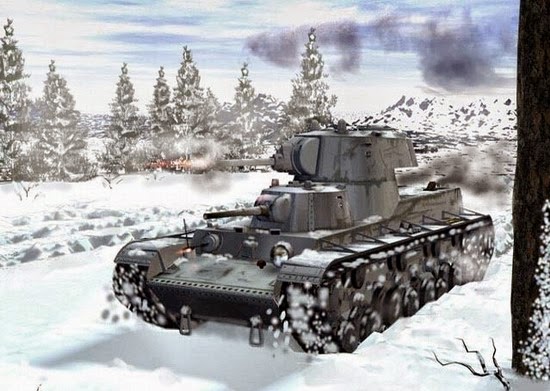
Tanker's Tuesday: Kirov Tank T-100

Kirov Tank T-100

The T-100 was a twin-turreted Soviet heavy tank prototype, designed in 1938–39 as a possible replacement for the T-35. The T-100 was designed to by N. Barykov's OKMO design team at S.M. Kirov Factory No. 185 in Leningrad. It was in competition with a similar design - the SMK - but neither were adopted and instead a single turret version on the SMK was ordered as the KV-1.


-DEVELOPMENT:
The project was initiated by the Red Army's need to replace the aging five-turreted T-35 tank based on combat experience in the Spanish Civil War. One of the lessons the Red Army drew from this conflict was the need for heavy 'shell-proof' armor on medium and heavy tanks. Although the T-35 was never used in Spain, its thin armor was vulnerable to the small towed antitank guns and gun-armed tanks encountered there by Soviet T-26 and BT tanks.
The T-100 was in direct competition against the very similar SMK heavy tank, by Lt-Colonel Kotin's team at the Leningrad Kirovsky Factory. The original specification was for a five-turreted "anti-tank gun destroyer" which would resist 37mm-45mm guns at any range and 76.2 mm artillery at 1,200 m. Both design teams objected to the antiquated multi-turreted design and the requirement was reduced to two turrets before serious design work began. Both tanks had some modern features, including thick, welded armor, radios and torsion bar suspension (another feature insisted upon by the design teams).

It was ordered as a successor of the mighty five-turreted T-35, world's heaviest tank of the Interbellum. The SMK (Sergey Mironovich Kirov, after a prominent Bolshevik leader assassinated in 1934) was to meet the requirements that were put forth by the Directorate of Armed Forces (ABTU) in November 1937. These requirements called for a tank that could withstand shots from a 76.2mm gun from 3,937 ft (1,200 m). It was also to be powered by a diesel engine as it was felt gasoline was too dangerous in case of hit. The requirements also called for a tank with five turrets. In 1938 the SMK was designed by Colonel Zh. Kotin (chief engineer of the Kirov Works in Leningrad) to replace the T-35. The initial study featured three turrets - the main one with a 76.2mm gun and two smaller offset ones with 45mm:


But this design was soon revised and the final layout had a 76.2 mm gun in the main turret and a 45mm in the lower turret, centerlined. This layout was virtually the same as it's competitors, T-100. The engine was based on a German BMW aircraft engine.

On May 4, 1938 the designs for the SMK and T-100 were presented to a joint committee from the Politburo and Defense Council. Both were approved to build prototypes.

The SMK prototype was completed in August 1939. It was sent to the Kubinka testing grounds outside of Moscow. The SMK was tested alongside the T-100 and KV-1 prototypes.

-DESCRIPTION:
The T-100 tank sported two turrets placed on a long chassis. The front turret, mounting a 45mm antitank gun, was placed at a lower elevation than the other, and as such had a limited area of fire. The top turret, mounting a 76.2mm gun, was able to turn a full 360 degrees. The multi-turret design concept had been common in the 1920s, with the British one-off Vickers A1E1 Independent influencing the Soviet T-35.

-SERVICE HISTORY:
The prototype T-100 tank was briefly tested alongside the other designs in the Soviet invasion of Finland in 1939 without success. It was never put into production, due to the archaic design concept, poor mobility and the availability of a far superior alternative, the KV series.The SMK was used in the Winter War with Finland. The T-100, SMK, and KV-1 prototypes were a part of the 91st Tank Battalion of the 20th Heavy Tank Brigade and had their first combat near Summa from December 17 to 19.5
In an attempt to rush a tank armed with a large howitzer capable of dealing with Finnish bunkers into use, one of the T-100s was converted into the SU-100Y self-propelled gun. It did not go into production, although the prototype was used in the defence of Moscow in 1941.

On December 19 the SMK and T-100 were joined by five T-28s and Red Army infantry. The SMK was immobilized by a mine which blew off one if its tracks. It was then found that during the repairs, under fire from the Finns, that the engine wouldn't restart. The T-100 was hooked up to it to try and tow it out of fire. But this was difficult in the icy conditions.


The SMK was eventually abandoned when the covering forces started to run low on ammunition. The SMK wasn't recovered until February 1940 when the Red Army broke through the Mannerheim Line.


There were attempts to use the T-100 chassis as a platform for an 6in howitzer carriage (T-100Z) and for self-propelled guns (here's one of several designs, the SU-100Y, armed with a 130mm naval gun).

Tuesday, June 4, 2013

Saturday, April 27, 2013

More Ebay Goodies


Flames of war German grenadier Company. Company command (2stands), 2 grenadier platoons,a hmg platoon, 3 stugIII's, 3 JgdpzIV's, a platoon of Luftwaffe 88's (yes ,painted luftwaffe blue as a lot were), a platoon of 5cm at guns, a platoon of 75mm infantry guns a painted and ready to use!. That 136 painted figs (guns incl) and 6 painted tanks.....not a bad haul...)