Showing posts with label . All Quiet On The Martian Front. Show all posts

Tuesday, September 19, 2017

Tanker's Tuesday : ARR There Be Pirates!

                                                  Iron Grip Pirate Scout
                                                   Iron Grip Pirate Tank
                                           Iron Grip Pirate Mobile Artillery

Iron Grip: Warlord is set in a dieselpunk world with a society that can be described as a blend of Napoleonic era politics and World War II technology. The Iron Grip world is home to many different landmasses, but Warlord focuses on Kathos, a frigid region to the northeast resembling Eastern Europe. Kathos is divided into two large military powers and a handful of neutral countries. To the north is the Sovereign Republic of Rahmos, possessing the world's most powerful airship fleet and a technologically advanced military. Their territory includes a number of client states in addition to their home island. The country of Fahrong (known as the Confederation of Nallum) is the other major power. With uneven and mountainous terrain, the Confederates employ mechanized walkers known as 'Arachs' along with the largest standing army. Central to the game is Atelia, a medium-sized country known for its abundant resources and many different ethnic and tribal groups. At the time of the game, Atelia is a country traditionally divided into city-states and nomads. Its lands are contested by the two Kathos military powers and the remaining scraps of the country are ruled by Warlords.

Tuesday, May 30, 2017

Tanker's Tuesday : German WWI Tanks and Armored Cars

A long and difficult start

While the British and the French were prompt to built their first operational tanks, the German high command was doubtful at best of their capabilities. That was until mid-1917 when came the successes that proved any well-coordinated attack using tanks in a proper way could break through and create havoc in rear lines. They had some reasons not to urge tank production. First, infantry, like the stürmptruppen (elite assault squads) were a simple and much cheaper way to achieve this breakthrough, as they had shown on many occasions throughout 1917 and particularly during the 1918 spring offensives. The military blockade also played a role, limiting the abilities of an already exhausted industry to produce enough materials and manpower to build swarms of tanks, reducing the chances to launch tank offensives at full force. There was also repugnance for this new “dishonorable weapon” as stated in propaganda and newspapers, coming from the ancient and very deep traditional ways of the Aristocratic Prussian officer, that dominated both the head of staff and the Kaiser himself.

WWI German Tanks And Armored Cars

Tuesday, December 27, 2016

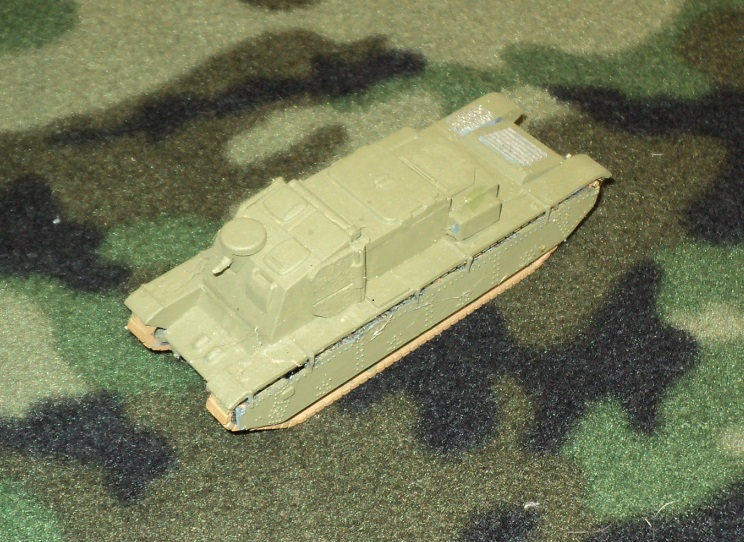
Tanker's Tuesday: Frederick IV Class Land Dreadnought

In keeping with my "All Quiet On The Martian Front" project and stealing liberally
from other sources, namely the BBC 's "THE GREAT MARTIAN WAR" . I thought
I'd do a German faction since I already had this monster built several years ago......) 


The reports that the Prussians were constructing a huge
heavily armed land iron clad at their workshop in Dioscuria
where proven correct today.

See First Report:
http://vsf15mm.blogspot.com/2007/04/desert-column-1884-5.html

The German government pledges that this new weapon will
only be used to engage Martian Tripods........
 
As reported earlier the Prussians are constructing a huge
heavily armed land iron clad at their workshop in Dioscuria.
Over the last several weeks large containers have been seen
being delivered to the Prussian holdings in Dioscuria from
Germany. These shipments although done with the greatest
of security, some of the markings on the containers have been
seen to be from the KRUPP manufactures in Essen, Germany.
Other containers were obviously of massive steam engine parts,
along with large amounts of sheet steel.
*Please note that as one of the competition rules is not to
post photos, I will hold back until the end of the 80 days.
The Frederick IV Class Land Dreadnought is a unique design
with a Tripod killing 150mm forward firing gun, two turret mounted
77mm guns and two sponson mounted 77mm guns, two quick
firing 45mm guns, and 3 Maxim machine guns. The design has
two steam boilers and two tracked drive trains The final stages
of construction are nearly completed.

Saturday, October 8, 2016

15mm Flames of War Trenchline System


Included in the box:

• 2x ‘L’ trench sections. • 2x ‘R’ trench sections. 2x ‘I’ trench sections. • 2x ‘Y’ trench sections. • 1x Packet of GFS001 Green Grass GF9 Grass. • 1x Packet of GFS017 Meadow Blend GF9 Grass.
Suitable for use with 10 - 15mm.
Sculpted by Jason Buyaki
The GF9 Static Grasses Included in the Box Set

Thursday, August 11, 2016

World War I French Aircraft


Listing of all aircraft deployed by the nation of France during World War 1 with history text, performance specifications and photograph images.

Friday, August 5, 2016

Bristol F.2 Fighter

 
The Bristol F.2 Fighter was a British two-seat biplane fighter and reconnaissance aircraft of the First World War developed by the Bristol Aeroplane Company. It is often simply called the Bristol Fighter or popularly the "Brisfit" or "Biff".


Top speed: 123 mph


Wingspan: 39′ 0″


Length: 25.82′


Retired: 1930


Unit cost: 1,350–1,350 GBP (1918)


First flight: September 9, 1916


Manufacturers: Standard Motor Company, Bristol Aeroplane Company


Sopwith 7F.1 Snipe

The Sopwith 7F.1 Snipe was a British single-seat biplane fighter of the Royal Air Force. It was designed and built by the Sopwith Aviation Company during the First World War, and came into squadron ...


Top speed: 121 mph


Wingspan: 31′ 0″


Length: 19.85′


Weight: 1,314 lbs


Engine type: Rotary engine


First flight: October 1917


Manufacturer: Sopwith Aviation Company

Tuesday, August 2, 2016

Airco DH.4


The Airco DH.4 was a British two-seater biplane of the First World War. It was the first British two seat light day-bomber to have an effective defensive armament. The DH.4 proved a huge success and was often considered the best single-engine bomber of the War. It was flown by a number of famous British and American aces, such as Frederick Cotton and Charles Bartlett.

Macchi M.5

 
The Macchi M.5 was an Italian single-seat fighter flying boat, designed and built by Nieuport-Macchi at Varese. It was extremely maneuverable and agile and matched the land-based aircraft it had to fight.

The M.5 was operated by five Italian maritime patrol squadrons as a fighter and convoy escort. By the end of World War I, these aircraft were flown by both United States Navy and United States Marine Corps airmen. The three versions of the airplane proposed include the model flown by the Italian ace Domenico Arcidiacono, an American plane flown by Willis B. Haviland and a captured Austrian plane piloted by Friedrich Welker.

Monday, August 1, 2016

Sopwith Camel

The Sopwith Camel was a British First World War single-seat biplane fighter aircraft introduced on the Western Front in 1917. Manufactured by the Sopwith Aviation Company, it used a rotary engine, and had twin synchronized machine guns. Though difficult to handle it offered very good maneuverability to an experienced pilot. Camel pilots were credited with shooting down 1,294 enemy aircraft, more than any other Allied fighter of the conflict. It also served as a ground-attack aircraft, especially towards the end of the war when it had become outclassed in the air-to-air role. The main variant was the F.1 but dedicated variants were built for a variety of roles including the 2F.1 Ship's Camel for carrier operations, the Comic night fighter, the T.F.1 trench fighter armored ground attack aircraft and as a two-seat trainer.

Sopwith Triplane

The Sopwith Triplane was a British single seat fighter aircraft designed and manufactured by the Sopwith Aviation Company during the First World War. It was the first military triplane to see operational service. The Triplane joined Royal Naval Air Service squadrons in early 1917 and was immediately successful. It was nevertheless built in comparatively small numbers and was withdrawn from active service as Sopwith Camels arrived in the latter half of 1917. Surviving Triplanes continued to serve as operational trainers until the end of the war.

Saturday, July 30, 2016

Hannover CL.III


The Hannover CL.III was a German military aircraft of World War I. It was a two-seat multi-role aircraft, primarily used as a ground attack machine.

Like the other Hannover "light-C-class", or "CL" designated aircraft, it included an unusual biplanar tail, allowing for a greater firing arc for the tail gunner. Until the introduction of this model, such tails had only been used on larger aircraft. The Hannover CL.IIIa in WW1 Wings of Glory is presented in versions flown by Rudolf Hager/Otto Weber and Johan Baur/Georg von Hengel, as well a Luftstreitkräfte model. 

Hanriot HD.1


The Hanriot HD.1 was a World War I single-seat fighter aircraft, combining clean lines with a light wing loading. Manufactured in France, the HD.1 was supplied to the Belgian and the Italian air forces, and it proved highly successful. It was flown by a number of the famous aces, such as Belgian Willy Coppens and Italians Mario Fucini and Silvio Scaroni.

Found my (stand in) Scout for Bombastian Air Force.


Caproni CA.3

I also picked up two of these for Bombastian Air Force
 
Just need a scout plane....)
 
The Caproni Ca.3 was an Italian heavy bomber that saw extensive use against the Central Powers forces. It was used from 1916 until the end of war by Italy, United Kingdom, France and USA. One of the most effective bombers of any air force during WWI, the Ca.3 was a wooden three-engine biplane, armed with twin 6.5 mm or 7.7 mm machine guns and 1,760 lb of bombs.